Ask ten people in Guwahati about rooftop solar and you’ll hear ten reasons not to bother. It won’t work in our rain. It costs a fortune. It’ll make the roof leak. Some of that comes from bad experiences with poorly installed systems. Some is left over from years ago, when panels really were expensive.
The numbers have moved since then. The Press Information Bureau reports that over 43 lakh households across India had gone solar under PM Surya Ghar as of June 2026, and Assam crossed one lakh installations by March 2026.
Here are the eight myths that come up most, with the honest answer to each. No sales pitch. Where the truth is “it depends,” we say so.
Myth 1: Solar panels don’t work on cloudy or rainy days
The reality: They do work, just at lower output. Panels convert diffuse light as well as direct sunlight. Under thick overcast, output typically falls to around 10–25% of normal, and thin cloud costs far less.
Assam’s monsoon months will produce less than the dry season, and there’s no point pretending otherwise. But a system is sized for the whole year, and net metering lets the surplus from bright months offset the duller ones. As a working rule, 1 kW of panels produces at least 100 units a month, and up to about 130 in summer. Our article on whether solar panels work on cloudy days or at night goes deeper.
Two things help in a wet climate. Monocrystalline panels handle low light better than older polycrystalline ones, so ask which type you’re getting. And your best generation months are the dry, clear ones from November to February, when Guwahati sees around seven or more hours of bright sunshine a day. A good design counts on both.
Myth 2: Solar is too expensive for an ordinary family
The reality: The sticker price looks big until you subtract the subsidy. For 3 kW and above, Assam households can receive up to ₹1,30,800 combined (₹85,800 central and ₹45,000 state), which takes well over half off the price of a typical 3 kW system. Banks can also finance up to 90% of the cost.
Here’s the arithmetic. A 3 kW system typically costs somewhere between ₹1.5 lakh and ₹2.5 lakh before subsidy. Subtract ₹1,30,800 and you’re paying roughly ₹20,000 to ₹1.2 lakh out of pocket, depending on the quote.
Most homes recover the investment in roughly four to seven years, depending on system size and how much electricity they use. After that, the panels keep going for two decades or more.
What about a zero bill? A right-sized system can bring your bill down a great deal, but fixed charges and taxes may still show up, and you’ll draw from the grid at night. Read our solar panel financing tips before you choose a loan.
Myth 3: You need batteries for solar to work
The reality: Most homes don’t. A grid-connected system sends surplus power to the grid through net metering, and you draw from it when the sun is down. The grid works as your storage.
Batteries add cost, wear out and get replaced every several years, and the PM Surya Ghar subsidy doesn’t cover them. The standard subsidised system is on-grid and needs no battery at all. A battery makes sense only if you want backup during power cuts.
“But what about night?” is the usual follow-up. Your evening and overnight use comes from the grid as normal. The units you exported during the day are credited against it on your bill, so they offset each other on your bill. The net meter APDCL installs records both directions.
Myth 4: Solar will keep my lights on in a power cut
The reality: A standard on-grid system shuts off when the grid fails. It does that on purpose, so power doesn’t flow back into lines that linemen think are dead. It’ll stay off even at noon on a sunny day.
To run during an outage you need a hybrid inverter and a battery. That’s a good option for areas with long, regular cuts, but it costs noticeably more. Ask any installer about this before you sign, not after.
Myth 5: Solar panels need constant maintenance
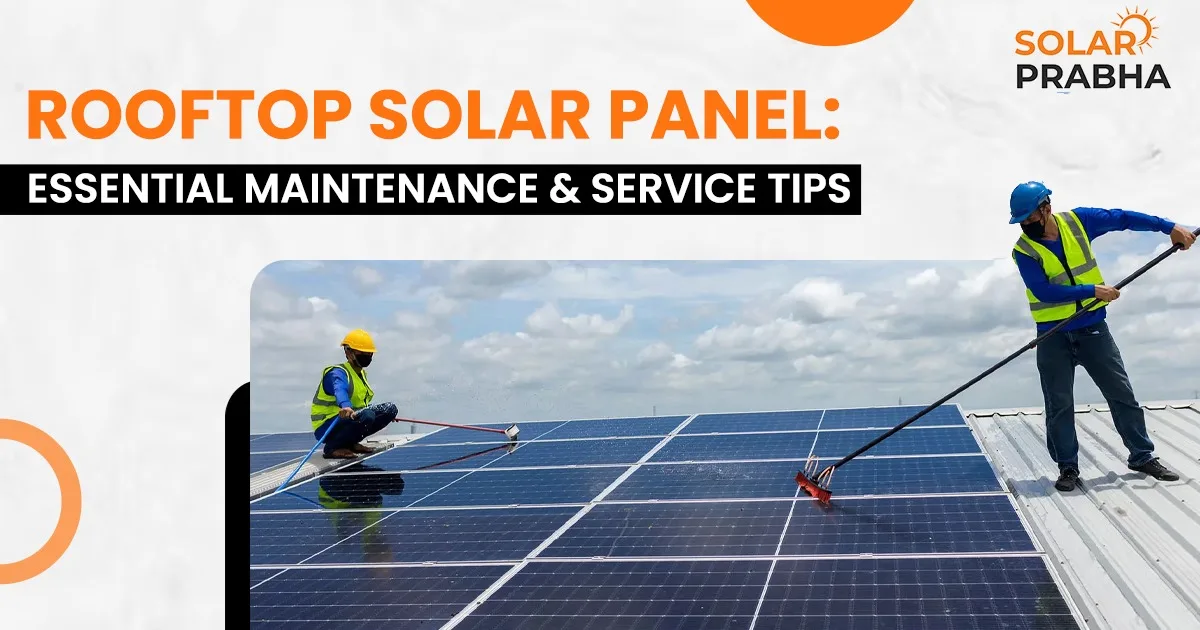
The reality: Panels have no moving parts. Rinse them a few times a year, and more often after a dusty spell. Assam’s rain does a lot of the cleaning for you.
What deserves real attention is shade. A tree branch that grows over one corner can cut output more than you’d expect, so trim it. Glance at the inverter display now and then, and have a technician check connections, earthing and the mounting structure once a year.
Be aware that the inverter is the part most likely to need replacing during the panels’ life. The EVVO and V-Sole inverters we supply carry an 8-year warranty. If your output ever looks low, our guide to calculating the efficiency of solar panels shows you how to check.
Myth 6: Panels damage the roof or make it leak
The reality: Done properly, they don’t. The mounting structure is anchored into the slab or beams, with waterproofing at each fixing point. The added load is modest, typically around 15–20 kg per square metre.
Leaks come from sloppy work. Before you sign, ask how the fixings will be sealed, whether the structure is hot-dip galvanised for Assam’s humidity, and whether it’s built to handle storm winds. If you have a tin-sheet roof, tell the installer at the start, because the structure is different from an RCC roof.
Myth 7: Panels wear out after a few years
The reality: They fade slowly. A large NREL study of solar panel degradation looked at more than 11,000 degradation rates and found a median loss of about 0.5% a year for crystalline silicon panels. After 25 years, a panel still delivers roughly 88% of its original output.
Manufacturer warranties reflect this. IB Solar panels carry a 12-year product warranty and a 30-year performance warranty. Pahal panels carry 10 years and 27 years. Read the small print, though. Warranties cover manufacturing defects. They generally don’t cover thunderstorms, floods, rat bites, physical damage or electrical faults, which is why proper earthing and surge protection matter.
Myth 8: My roof is too small for solar
The reality: Less space is needed than most people think. Roughly 100 sq ft per kW: about 300 sq ft for a 3 kW system and 500 sq ft for a 5 kW system. Most Guwahati homes can fit at least 2–3 kW.
Shade matters more than size. A small, south-facing roof with clear sky beats a large roof shaded half the day. If you don’t own your roof, note that the subsidy application needs proof of ownership or the owner’s consent.
Why these myths stick around
A few reasons keep coming up. Old information travels well: panels were far more expensive a decade ago, and that number is still in people’s heads. Different system types get mixed up, so a story about an off-grid battery setup gets applied to an on-grid one. Some homeowners had a poor installation and blamed solar itself. And now and then a seller oversells, promising a zero bill or backup power that the system was never designed to deliver.
How to spot a reliable installer
The best defence against every myth above is a good installer. Look for these signs:
- They’re an empanelled vendor on the PM Surya Ghar portal.
- They use ALMM-listed panels and name the brands in writing.
- They give a written quote listing panel wattage, inverter model, structure, earthing and paperwork.
- They explain warranty terms, including what isn’t covered.
- They have a local team who can reach your site when something needs fixing.
- They tell you when a smaller system is enough.
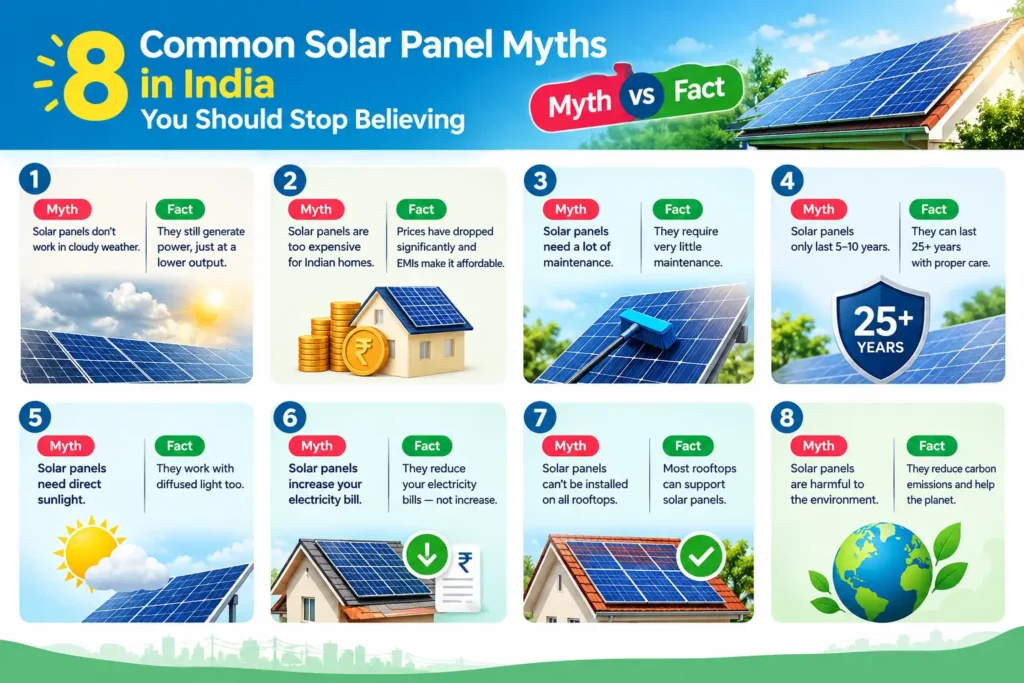
Myths vs facts at a glance
| Myth | The fact |
| Solar doesn’t work in cloud or rain | It works at reduced output, roughly 10–25% in thick overcast |
| Solar is too expensive | Up to ₹1,30,800 subsidy in Assam for 3 kW+, plus bank finance |
| You need batteries | Not for on-grid systems with net metering |
| Solar keeps lights on in a cut | Not unless you add a hybrid inverter and battery |
| Constant maintenance | Occasional cleaning and a yearly check |
| Damages the roof | Not when properly installed and sealed |
| Panels die in a few years | About 0.5% output loss a year, 25–30 year performance warranties |
| Roof is too small | Around 100 sq ft per kW |
Not sure what applies to your roof?
Every house is different. Solar Prabha offers free solar consultations in Guwahati, and we’ll tell you what fits your roof, your bill and your budget. That includes telling you when a smaller system is the smarter buy. Call +91-7099030047.
Frequently asked questions
Do solar panels work in Assam’s rainy season?
Yes. They produce less on thick, cloudy days, roughly 10–25% of normal, but they still generate. Annual production is what counts, and systems are sized with the monsoon in mind.
How long do solar panels last in India?
Most panels are warranted for 25–30 years of performance. They typically lose around 0.5% of output per year, so they keep producing well beyond their payback period.
Do I need a battery with rooftop solar?
Not for a standard on-grid system with net metering. You only need one if you want power during grid outages.
Do solar panels damage roofs?
No, when installed correctly. Proper anchoring, sealed fixings and a galvanised structure keep the roof safe and watertight.
How much roof space does a solar system need?
About 100 sq ft per kW. A 3 kW system needs roughly 300 sq ft, and a 5 kW system needs about 500 sq ft.