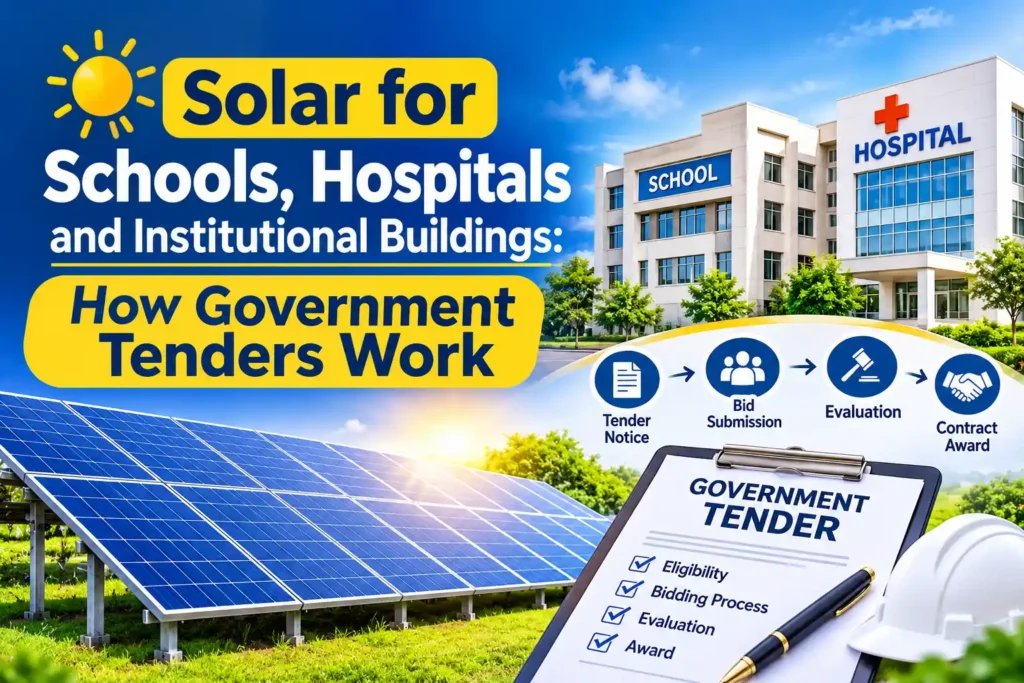
A school runs on daylight. A hospital runs on every hour of the day. Both pay a power bill that never takes a holiday, and both usually have large, flat roofs sitting empty under the sun.
That’s why institutional buildings are among the best candidates for rooftop solar. It’s also why the government now wants its own buildings to go solar. In Assam, APDCL is running large rooftop tenders for government buildings under PM Surya Ghar. If you manage a school, hospital, college or trust, or you’re a contractor trying to make sense of one of these tenders, this guide explains how the pieces fit together.
Quick answer: Institutions in Assam can go solar in two ways. Under CAPEX, you pay for the plant, own it and keep all the savings. Under RESCO, a developer pays for and runs the plant, and you buy the power at a fixed per-unit tariff. Government buildings in Assam are being solarised through APDCL’s RESCO tenders, with an approved ceiling tariff of ₹4.37 per unit. Private non-profit schools and hospitals can pick either route directly. Hospitals that need power around the clock should plan for a battery or a hybrid setup on critical loads.
Why institutions suit solar so well
- Daytime load. Classrooms, offices, labs and outpatient departments use most of their power while the sun is up, which is when panels produce the most.
- Roof space. As a rough guide, a system needs about 100 sq ft per kW. A 5,000 sq ft roof can host around 50 kW, which at 100 to 130 units per kW per month means roughly 5,000 to 6,500 units a month.
- Predictable bills. A fixed-cost solar plant takes a large slice of an institution’s unpredictable energy spend off the table.
There are two honest limits. Schools sit empty on Sundays and during vacations, so those days’ output is exported to the grid and credited through net metering. Our guide to net metering in Assam explains how the credits work. And hospitals draw power through the night, when panels produce nothing, so night load stays on the grid, a generator or a battery.
CAPEX vs RESCO: which model fits?
| CAPEX | RESCO | |
| Who pays upfront | The institution | The developer |
| Who owns the plant | The institution | The developer, for the contract term |
| What you pay for power | Nothing per unit. You save on the bill | A fixed tariff per unit generated |
| Who maintains it | You, usually under warranty and an AMC | The developer |
| Best for | Institutions with funds, a grant or a trust budget | Institutions with no capital budget, or where tender rules require it |
A Ministry of Jal Shakti circular on rooftop solar for government buildings notes that, in CAPEX mode, the investment can usually be recovered from bill savings within about four to five years. It also describes RESCO as the equivalent of an operating-expense model, where the consumer carries no initial capital cost. You can read the full Jal Shakti circular on solarising government and institutional buildings.
The decision usually comes down to one comparison: the RESCO tariff against the per-unit cost on your current APDCL bill. As an illustration, suppose your bill works out to ₹8 a unit and a RESCO tariff comes in at the ₹4.37 ceiling. On 5,000 to 6,500 solar units a month, that gap is worth roughly ₹18,000 to ₹23,600 a month, with no capital outlay. Plug in your own numbers, because your bill will differ.
How government building tenders work in Assam
The framework is set at the national level. MNRE issued operational guidelines in July 2024 for saturating government buildings with rooftop solar under PM Surya Ghar. The Governor of Assam then notified APDCL as the nodal agency for rooftop solar on government buildings in the state. The tender documents state that no central financial assistance is provided for these government-building projects, so they run on the RESCO route or on department budgets.
Here’s what has happened since:
- February 2025: APDCL invited bids for 134 MW of rooftop solar on government buildings across Assam under the RESCO mode, split into regional packages.
- September 2025: The Assam Electricity Regulatory Commission approved a ceiling tariff of ₹4.37 per kWh for these projects. Mercom India’s report on the approval explains that developers sell power directly to the government building at a fixed tariff, and surplus electricity is exported to the APDCL grid through export-import metering.
- October 2025: APDCL invited bids for a further 67 MW, split into Lower Assam (28.7 MW), Central Assam (21 MW) and Upper Assam (17.3 MW), through tariff-based bidding followed by an e-reverse auction.
Schools have their own track. A January 2024 tender covered on-grid and off-grid solar plants at PM SHRI schools under Samagra Shiksha in Assam, and the tender document notes 264 government schools in the state under the PM SHRI scheme. New notices keep appearing, so it pays to watch APDCL’s tender page regularly.
What bidders are asked for
Using APDCL’s 67 MW tender as an example, Energetica India reported these requirements:
| Requirement | Detail |
| Ceiling tariff | ₹4.37 per unit |
| Earnest money deposit | ₹840 per kW of quoted capacity |
| Tender document fee | ₹29,500, including GST |
| Technical experience | Lead member has executed solar projects of at least 10% of the tendered capacity in the last seven years, plus at least one rooftop plant of 50 kWp or more, operating for six months or longer |
| Minimum net worth | ₹84 lakh per MW |
| Average annual turnover | ₹2.1 crore per MW over the last three financial years |
| Consortiums | Up to three members, with the lead holding at least 51% equity and each other member at least 20% |
Packages of this size generally go to large developers, who then need local teams and suppliers to build the plants. Smaller institutions, trusts and departments buy rooftop systems directly, and their requirements are lighter, though the same pattern of experience, finances and documentation usually applies.
Seven checks before an institution signs
- The roof. Confirm its age, structural condition and waterproofing. Government buildings also need the department’s consent.
- Twelve months of bills. Look at monthly units, sanctioned load and how much of your use falls between 9 am and 4 pm.
- The system type. Schools usually do well with a simple on-grid plant. Our comparison of on-grid vs off-grid solar systems helps you pick.
- The equipment. Ask for ALMM-listed panels and named inverter brands, with written warranties. For reference, IB Solar panels carry a 12-year product warranty and 30-year performance warranty. Pahal panels carry 10 and 27 years. EVVO and V-Sole inverters carry 8 years.
- Safety. A school or hospital roof needs proper earthing, surge protection and a lightning arrestor. Assam’s storm season is no place to skip these.
- Approvals. APDCL has to inspect the plant and install the net meter before it counts. Ask who handles that paperwork.
- The contract. For RESCO, read the tenure, tariff terms, buy-out clause and what happens to the plant at the end. For CAPEX, read the maintenance and response-time commitments.
Special points for hospitals
Rooftop solar cuts a hospital’s daytime bill, but it doesn’t replace emergency power by itself. Operation theatres, ICUs, labs and cold storage need an uninterrupted supply, and that comes from a designed combination of the grid, a generator and, if the budget allows, battery storage on critical circuits. A hybrid inverter and battery add cost, and the PM Surya Ghar subsidy doesn’t cover them. Talk to a qualified electrical engineer before changing how your emergency supply is wired.
Roof layout matters too. Water tanks, air-conditioning units and stairwell structures throw shadows that cut output, so plan panel placement around them.
Special points for schools
Schools are the easy case. Load and sunshine match, so a plain on-grid system without a battery usually does the job. A few practical notes:
- Restrict student access to the roof and plan safe maintenance routes.
- Make use of the plant educationally. Many schools put a generation display near the entrance.
- Plan for vacations. Output in those weeks gets exported and credited, so a slightly larger system isn’t wasted.
Solar Prabha for institutional projects
Solar Prabha is a Guwahati-based EPC company and wholesaler. We supply panels from IB Solar and Pahal, EVVO and V-Sole inverters, mounting structures, cables, distribution boxes, earthing and lightning protection, and we handle energy audits, design, installation and after-sales service. Send us twelve months of electricity bills and the roof dimensions of your school, hospital or office, and we’ll give you a realistic capacity, an itemised quote and a clear view of CAPEX versus RESCO for your case. Call +91-7099030047.
Frequently asked questions
Is there a subsidy for solar on schools and hospitals in Assam?
For government buildings under PM Surya Ghar, the tender documents state that no central financial assistance is provided. Support for non-government institutions has varied over the years, so check the current position with AEDA or MNRE before you plan around it.
What does RESCO mean?
RESCO stands for Renewable Energy Service Company. A developer builds, owns and runs the solar plant, and the building buys the electricity at an agreed per-unit tariff, with no upfront cost.
Which is better for a school, CAPEX or RESCO?
If the school has funds, CAPEX gives the biggest long-term savings. If funds are tight or tender rules require it, RESCO delivers savings from day one. Compare the RESCO tariff with your current per-unit cost to decide.
Can a hospital run entirely on rooftop solar?
Not on rooftop solar alone. Panels produce only in daylight, so a hospital needs the grid, a generator or a battery for night and emergency loads. Solar cuts the bill and the fuel use.
Who invites government solar tenders in Assam?
APDCL is the nodal agency for rooftop solar on government buildings in the state. Education tenders, such as the PM SHRI schools project, have come through Samagra Shiksha, Assam.
How much roof space does a 50 kW system need?
Roughly 5,000 sq ft of shade-free roof, based on about 100 sq ft per kW.