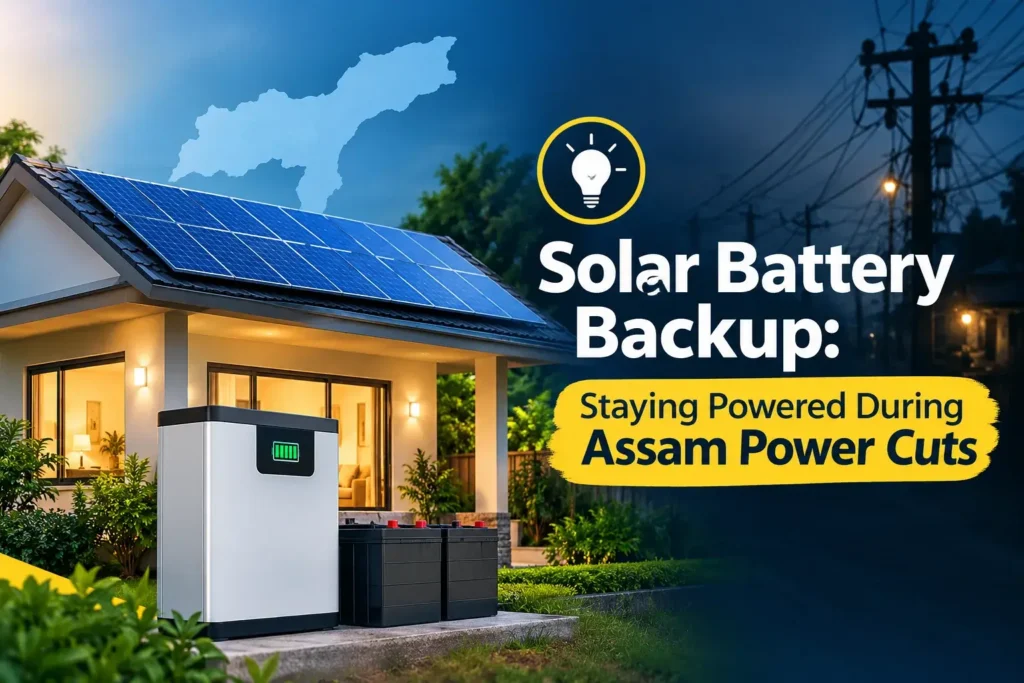
At the end of May 2025, days of incessant rain left parts of Guwahati without electricity for long stretches. The Assam Tribune reported outages in some localities lasting well beyond 24 hours, and APDCL switched off distribution transformers in waterlogged areas as a safety measure. Anyone who has lived through an Assam monsoon knows the pattern.
Here’s the part that catches many rooftop solar owners off guard. A standard grid-connected system shuts down the moment the grid does, even at noon under a clear sky. It’s built that way, and it’s why your panels can’t act as your backup unless you add a battery.
Quick answer: To keep the lights on during a power cut, you need a battery and a hybrid (or off-grid) inverter. Backing up essentials like lights, fans, a router and the fridge for four to six hours usually needs around 3–5 kWh of battery. The battery and hybrid inverter typically add ₹1.2 lakh to ₹3.5 lakh on top of the panels, depending on the battery type.
Why your on-grid solar system goes dark in a blackout
An on-grid inverter follows the grid. It matches the grid’s voltage and frequency, and the moment the grid drops out, it has to stop feeding power almost immediately. This is called anti-islanding protection.
Without it, your panels would push electricity into lines that APDCL linemen believe are dead, and that’s how people get hurt. So the shutdown isn’t a fault. It’s the inverter doing what it was certified to do.
The upshot: if you want power during an outage, the solar system needs a way to run on its own. That means storing energy in a battery and using an inverter that can safely disconnect from the grid and keep supplying your home.
Three ways to get backup
| Setup | How it works | Power in a cut? | Cost | Subsidy |
| On-grid solar plus a separate home inverter | Solar feeds the grid. An ordinary inverter battery runs chosen circuits | Yes, from the inverter battery (charged from the grid, not from solar) | Lowest | Solar part may qualify |
| Hybrid (on-grid plus battery) | Panels run the home and charge the battery. The grid tops up. Essentials keep running in a cut | Yes, and solar keeps recharging the battery | Highest of the grid-tied options | Confirm with your vendor before ordering |
| Off-grid | No grid connection. Panels, battery and inverter only | Yes, it’s the only source | High | Generally none |
A basic on-grid inverter is the cheapest way to cut your bill, and it works with net metering. Our guide to on-grid vs off-grid solar systems sets out the trade-offs in more detail. A hybrid system keeps net metering and adds backup. If you’re weighing that, our explainer on net metering in Assam shows how exported units are credited.
Lithium or lead-acid?
| Tubular lead-acid | LiFePO4 (lithium) | |
| Rough price | ₹25,000–₹55,000 for 3–5 kWh | ₹80,000–₹2 lakh for 3.8–10 kWh |
| Usable capacity | About 50% of rated | 90% or more of rated |
| Typical life | Roughly 3–5 years, less in heat | 10–15 years, 3,000–5,000+ cycles |
| Upkeep | Water top-ups, bulky | Little, compact |
Lead-acid costs less on day one. Lithium usually wins on cost per year of use, especially if your area has long or frequent outages. Lead-acid still makes sense on a tight budget where cuts are short and occasional. These are indicative 2026 market ranges, and brands vary.
One catch with lead-acid: because you can only use about half its rated capacity, you need to buy roughly double what your load calculation says.
How big a battery do you need? A worked example
Take an evening outage of five hours, with only essentials running:
| Load | Watts | Hours | Energy (Wh) |
| 4 LED bulbs | 36 | 5 | 180 |
| 3 ceiling fans | 210 | 5 | 1,050 |
| Wi-Fi router | 15 | 5 | 75 |
| TV | 100 | 3 | 300 |
| Fridge (average draw) | 60 | 5 | 300 |
| Phone and laptop chargers | 20 | 5 | 100 |
| Total | about 2,000 Wh (2 kWh) |
The formula is simple:
Battery size (kWh) = energy needed × 1.2 (for inverter losses) ÷ usable depth of discharge
For this home, that’s 2 × 1.2 = 2.4 kWh of usable energy.
- Lithium (90% usable): about 2.7 kWh, so a 3–3.8 kWh battery covers it comfortably.
- Lead-acid (50% usable): about 4.8 kWh, which is roughly two 12V 200Ah batteries.
A 2–3 kVA hybrid inverter handles this load and leaves room for the start-up surge of a fridge or water pump.
Air conditioners change the picture completely. A single 1.5-ton inverter AC can draw around 1.3–1.5 kW, so six hours of running needs somewhere near 8–9 kWh by itself. Most homes leave the AC off the backup circuit for that reason.
What does it cost?
Market guides in 2026 put a hybrid inverter at roughly ₹35,000 to ₹90,000 for the 3–5 kVA range. A 3–5 kWh battery with hybrid inverter, wiring and installation commonly totals ₹1.2 lakh to ₹3.5 lakh, with panels priced separately. For a whole 5kW hybrid system, published estimates run from about ₹4.8 lakh to ₹6 lakh with a tubular battery, and ₹5.5 lakh to ₹7 lakh with lithium, before subsidy. That is roughly 40–60% more than the same size of on-grid system.
Get a written quote that separates the panels, hybrid inverter, battery and installation. It’s the only way to compare like with like.
Does the PM Surya Ghar subsidy cover batteries?
No. The scheme supports the solar plant of a grid-connected system, and the subsidy amount depends on the kW capacity of the plant, not on the battery. A battery is an extra cost. Officials have talked about bringing storage into the scheme as prices fall, but there’s nothing to plan around today. Check the current rules on the official PM Surya Ghar portal before you order.
Practical tips for Assam homes
- Back up essentials only. Ask for a separate backup distribution board carrying lights, fans, router and fridge. Keep the AC and geyser on the grid side.
- Raise the battery above flood level. Waterlogging is a real risk in parts of Guwahati. Keep the battery dry, ventilated and out of direct sun.
- Read the battery warranty properly. Look at the number of cycles, the years covered, and the capacity it must still hold at the end. A “10-year warranty” can hide tight conditions.
- Check certifications. Insist on a battery management system and test reports. The Bureau of Energy Efficiency runs a Standards and Labelling programme that now includes grid-connected solar inverters, which gives you one more efficiency benchmark to ask about.
- Add surge protection and proper earthing. Storms bring both outages and voltage spikes.
- Plan ahead. Many on-grid inverters can’t take a battery later. If backup might matter in a few years, ask about a hybrid-ready inverter at the start.
Do you actually need a battery?
- A few short cuts a month: a regular home inverter or UPS is cheaper.
- Long or regular cuts, work-from-home, medical equipment, a water pump, or a shop: a hybrid system earns its cost.
- A remote site with unreliable or no grid: off-grid is worth a serious look.
If you’re not sure which group you’re in, keep a simple log for a month: when the power goes and for how long. It makes the conversation with any installer much more useful.
Solar Prabha supplies solar inverters, storage and the rest of the system across Guwahati and Assam. Tell us your essential loads and typical outage length, and we’ll size a battery around them. Call +91-7099030047.
Frequently asked questions
Will my rooftop solar system work during a power cut?
Not if it’s a standard on-grid system. It shuts down automatically for safety when the grid fails. You need a hybrid inverter with a battery, or an off-grid system, to keep running.
Can I add a battery to my on-grid system later?
Sometimes, but often it means changing the inverter. If you think you’ll want backup, choose a hybrid-ready inverter when you install.
How long will a solar battery last during an outage?
It depends on the battery size and what you run. A 3–5 kWh battery typically carries lights, fans, a router and a fridge for four to six hours. Adding an AC shortens that a lot.
Is lithium better than tubular for solar backup?
For most homes with regular outages, yes. Lithium lasts longer and lets you use more of its capacity, though it costs more upfront. Tubular batteries suit tight budgets with short, occasional cuts.
Does the solar subsidy cover a battery?
No. PM Surya Ghar subsidy applies to the solar plant of a grid-connected system. A battery is an added cost.