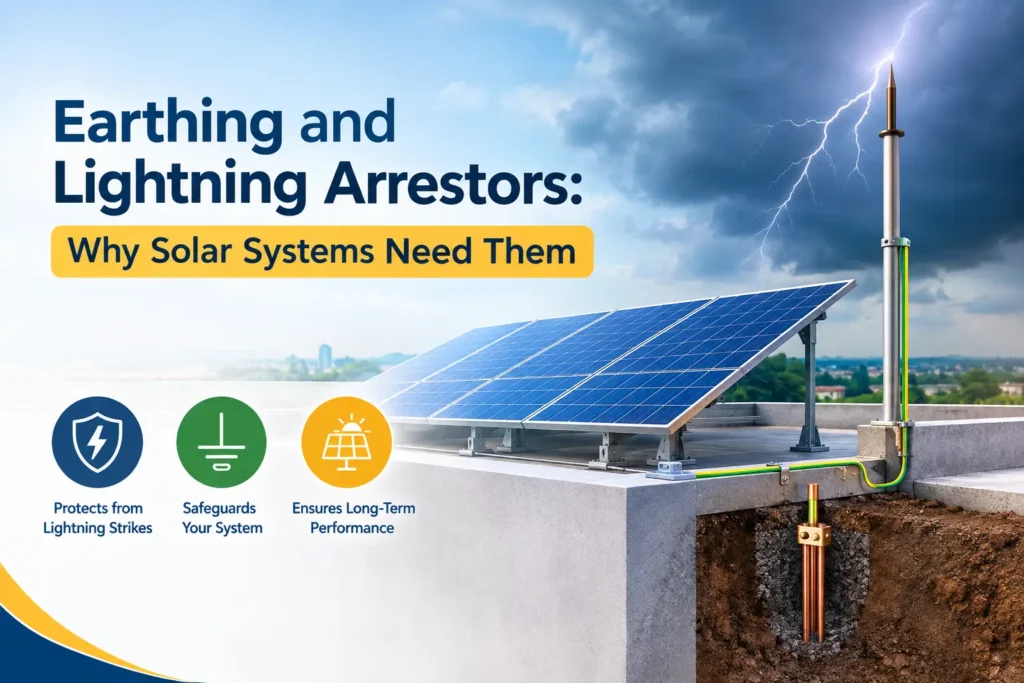
When the pre-monsoon storms roll across the Brahmaputra valley, lightning is part of the season. The Assam Tribune, citing figures from the Assam State Disaster Management Authority, reported that lightning has killed more than 400 people in the state over the past decade, with 2024 the deadliest year since 2016 at 51 deaths.
Now picture your rooftop. A large metal-framed array, sitting at the highest point of your building, connected by cable to an expensive inverter and your home’s wiring. That is exactly the kind of setup that needs a planned path for electricity to reach the ground.
Quick answer: Yes. Every rooftop solar system needs earthing, and in Assam a lightning arrestor plus surge protection is strongly advised on top of it. Earthing gives fault current and surges a safe route into the ground, which protects people and the inverter. The lightning arrestor gives a strike somewhere to land that isn’t your panels. They work as a pair, and one doesn’t replace the other.
What earthing actually does
Your panel frames, mounting structure and inverter casing are all metal. If a cable insulation fails or a surge arrives, that metal can become live. Without a proper earth connection, the “somewhere else” for that current to go could be a person touching the terrace railing.
An earthing system fixes this with three parts: an electrode buried in the ground (the earth pit), a conductor strip or cable joining it to the metalwork, and connections at every metal part of the system. Fault current takes that easy path down instead of through you. It also lets breakers, RCCBs and surge protectors do their job properly, because they need a solid earth to work against.
Earthing, lightning arrestor and surge protector are three different things
People often use these words as if they mean the same thing. They don’t.
| Component | Its job | Where it sits |
| Earthing (earth pits) | Carries fault and surge current safely into the ground | Buried pits, connected to frames, inverter and arrestor |
| Lightning arrestor (rod or air terminal) | Intercepts a direct strike and leads it to a dedicated earth | On the roof, positioned so the array sits inside its protection zone |
| Surge protection device (SPD) | Clamps voltage spikes travelling along cables | Inside the DC and AC boxes near the inverter |
Here’s why you want all three. Many damaging surges don’t come from a strike on your roof. A hit on a nearby tree, pole or transformer can push a spike of voltage along the wiring into your home. The arrestor handles the direct hit. The SPDs handle the spike that travels. The earth pits handle whatever the other two send down.
What the rules say
- The Central Electricity Authority’s Safety Regulations, 2023 cover the safe construction, installation and maintenance of electrical installations, including earthing. You can read the full CEA Measures relating to Safety and Electric Supply Regulations on the CEA website.
- Indian practice follows IS 3043 for earthing and IS 2309 / IEC 62305 for lightning protection. MNRE’s rooftop solar specifications point installers to IS 3043 for grounding.
- The general ceiling for earth resistance is 5 ohms. Many installers aim for 1 ohm or less on the inverter and lightning pits, because readings tend to creep up in dry weather.
How many earth pits does a home system need?
Good practice is three separate pits:
- One for the panel frames and mounting structure
- One for the inverter and AC side, including the surge protector
- One dedicated pit for the lightning arrestor
If the building has no lightning arrestor, two pits is the acceptable minimum. The lightning pit is usually kept some distance away from the others, commonly around three metres, so a strike’s energy doesn’t share a path with the electronics. Every pit should be tested with an earth tester at handover, and you should get the readings in writing.
Why chemical earthing suits Assam
A chemical earthing set uses a copper-bonded electrode inside a pit filled with a conductive backfill compound. The compound holds moisture and keeps resistance low. Our chemical earthing page explains the components.
The Assam angle matters here. Soil moisture swings between a drenched monsoon and a dry winter, and Guwahati’s driest months fall between November and February. A plain GI rod in sandy or rocky ground can read well in July and badly in January. A chemical earth stays steadier through that swing, which is why it’s popular for solar in places with poor or seasonally dry soil.
What happens if you skip it
- Your inverter takes the hit. Surges travel in through the DC and AC cables. The inverter’s electronics are usually the first thing to go.
- Metal parts can turn live. A cable fault can energise a frame or railing, and someone on the terrace pays for it.
- Fire risk goes up. Arcing at a damaged connection can ignite nearby material.
- Warranty won’t rescue you. Read the warranty manual of almost any panel or inverter and you’ll find that lightning and thunderstorm damage is excluded. Your protection setup is effectively your only insurance.
- Inspections can get awkward. APDCL inspects and commissions a system before net metering, and the PM Surya Ghar subsidy claim follows the commissioning report. A properly documented earthing setup is one less thing to get flagged.
What a proper setup includes
- Separate, labelled earth pits with inspection covers, so they can be checked and watered
- Copper-bonded or chemical electrodes suited to the soil at your site
- All module frames and structure bonded with correctly sized copper or GI strips
- A lightning arrestor placed on the roof so the array sits within its protection zone, with its own down conductor and earth
- Type 2 surge protectors on both the DC and AC sides
- An earth-resistance test report, handed to you at commissioning
When you compare quotes, check that these items are listed. A low price sometimes means the earthing was quietly trimmed. It’s a modest line in the budget compared with the panels and inverter it protects.
Installation mistakes to watch for
Most earthing problems come from shortcuts taken on the day, not from the equipment. Ask about these before the crew arrives:
- One shared pit for everything. Frames, inverter and arrestor all landing in a single pit means a strike’s energy runs through the same path as your electronics.
- Connecting the arrestor straight into the inverter earth. A direct link can let surge current flood the inverter’s ground. The lightning pit should be bonded as the design specifies, not simply tied on.
- Pits buried with no inspection cover. If nobody can open the pit, nobody can test it or top up moisture later.
- Thin or unsuitable strips. Undersized conductors and the wrong metal corrode quickly in Assam’s humidity.
- No handover paperwork. If there’s no test report, there’s no proof the earth works. Get the readings in writing, with the pit locations marked.
- Panels sitting outside the arrestor’s protection zone. An arrestor only shields the area it covers. Its height and position need to suit the array.
Keep it working: maintenance before storm season
- Test earth resistance every year, ideally in March, before the pre-monsoon thunderstorms begin. In the Northeast, those storms are most active between March and May.
- Inspect strips and clamps for corrosion, loose fittings or theft. Copper strips are a target in some areas.
- Follow the supplier’s guidance on topping up moisture in the pit, since some designs need occasional watering in dry months.
- Stay off the roof during a thunderstorm. Nothing there is worth the risk.
- Get the system checked after a nearby strike, even if everything seems to be working.
Lightning is becoming a bigger concern nationally. The Annual Lightning Report 2024–25, prepared by CROPC with the India Meteorological Department and the Ministry of Earth Sciences, found lightning strikes rising sharply across India in recent years. Protection that felt optional a decade ago is now ordinary good sense.
Getting it done right
Solar Prabha supplies chemical earthing kits and lightning arrestors along with the panels, inverters and cabling for rooftop projects across Guwahati and Assam. If you’re planning a new installation, our guide to residential solar installation in Assam covers the other things to check in a quote. To talk through your roof and site, call +91-7099030047.
Frequently asked questions
Is earthing mandatory for rooftop solar in India?
Yes. Electrical installations must be earthed under the CEA’s safety regulations, and rooftop solar specifications follow IS 3043 for grounding. Installations are inspected before net metering and subsidy release.
Can lightning damage solar panels?
Yes, either through a direct strike or through voltage surges induced in the cables by a nearby strike. The inverter is usually the most vulnerable part. Earthing, a lightning arrestor and surge protectors reduce that risk.
How many earth pits does a solar system need?
Best practice is three: one for panel frames and structure, one for the inverter and AC side, and one for the lightning arrestor. Two is the minimum when there is no arrestor.
What earth resistance is acceptable for solar?
Under 5 ohms is the general ceiling. Many installers target 1 ohm or less for the inverter and lightning pits, and test again each year.
Does a lightning arrestor make a solar system lightning-proof?
No. It greatly lowers the risk from a direct strike, but no system is fully immune. That’s why surge protectors and proper earthing are part of the design too.