If you’ve asked two installers for a 5kW quote, you’ve probably got two very different numbers. That’s normal. The price depends on panel technology, inverter brand, structure, cabling and how much of the paperwork is included. What most people really want to know is simpler: what will I actually pay, after subsidy, and will it pay back?
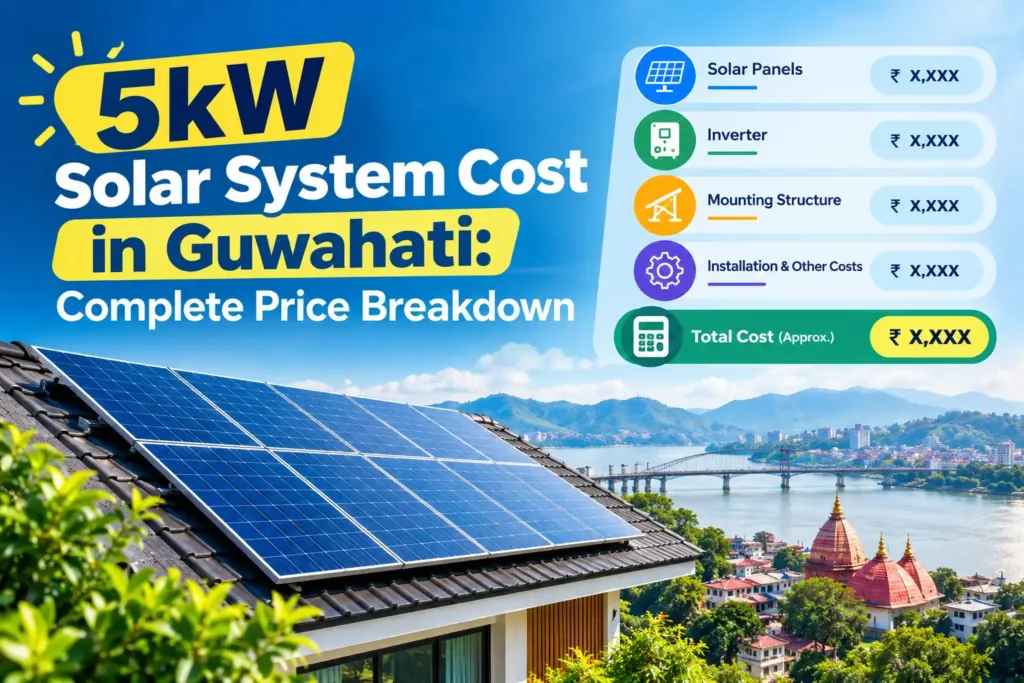
Quick answer: A 5kW on-grid rooftop solar system in Guwahati costs roughly ₹2.8 lakh to ₹3.6 lakh installed in 2026. With Assam’s combined subsidy of ₹1,30,800 (central plus state), your net cost lands around ₹1.5 lakh to ₹2.3 lakh. Adding a battery and hybrid inverter raises the total by another ₹1.2 lakh to ₹3.5 lakh.
Who needs a 5kW system?
A rough rule: 1 kW of panels makes about 100 to 130 units a month. So a 5kW system produces roughly 500 to 650 units a month. It suits:
- Homes with a monthly APDCL bill of around ₹3,000 to ₹6,000
- Households running two or three ACs, plus a fridge, pump and geyser
- Clinics, small offices and shops with strong daytime use
Space and load matter too. You’ll need roughly 500 sq ft of shade-free roof, which fits about 9 to 10 panels of 540–550 Wp each. Your sanctioned load also plays a part, since system size generally can’t exceed it. If your sanctioned load is lower than 5 kW, ask about a load enhancement before you apply.
What does a 5kW system cost in Guwahati?
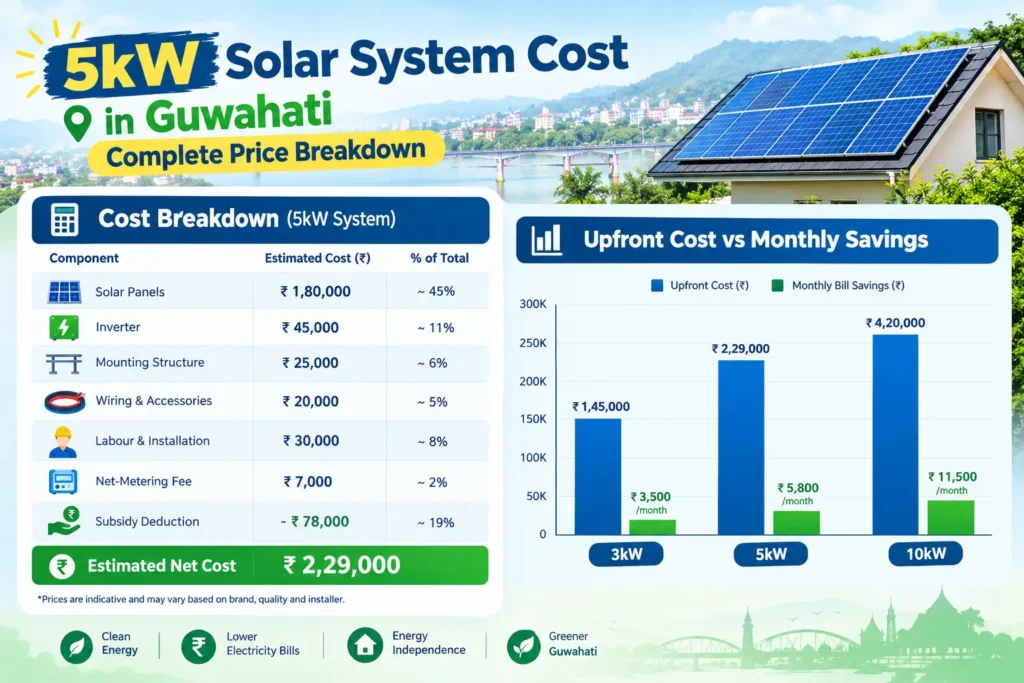
Published 2026 estimates cluster in a fairly tight range. Regional installer guides put a 5kW on-grid package at around ₹3.25 lakh in Assam, while national figures run lower, near ₹2.8 lakh. Expect ₹2.8 lakh to ₹3.6 lakh, with these things pulling the price up or down:
- Panel technology and brand. TOPCon panels cost more than mono PERC but produce a bit more.
- Inverter brand and warranty. A longer warranty usually means a higher price.
- Structure. Hot-dip galvanised, wind-rated structures cost more than light ones, and they matter in Assam’s storms.
- Roof type and height. A tin roof or an elevated structure needs more steel.
- Cable runs. A long distance between the roof and the meter board adds cable and labour.
Since September 2025, GST on rooftop solar equipment is 5%, which has helped bring prices down compared with a year ago.
Where the money goes
This is a rough split of a typical 5kW quote. Your own quote will differ, but the shape holds.
| Item | What you get | Rough share of the price |
| Solar panels | 9–10 panels, 540–550 Wp, ALMM-listed and DCR-compliant for subsidy | 45–50% |
| On-grid inverter | 5 kW inverter with Wi-Fi monitoring | 10–12% |
| Mounting structure | Galvanised structure, wind-rated | 10–12% |
| Electricals and protection | Cables, AC and DC distribution boxes, earthing, lightning arrestor, surge protectors | 8–10% |
| Installation and paperwork | Labour, transport, net-metering and subsidy filing | 12–15% |
Make sure earthing and lightning protection appear as separate lines in any quote. A cheap quote sometimes gets there by leaving them out.
How much subsidy do you get in Assam?
Assam households can claim two subsidies on a grid-connected residential system:
- Central subsidy (PM Surya Ghar): ₹85,800 for systems of 3 kW and above
- Assam state subsidy: ₹45,000 for systems of 3 kW and above
- Total: ₹1,30,800
The catch: the subsidy stops growing at 3 kW. A 5kW system gets the same ₹1,30,800 as a 3kW system, so the subsidy covers a smaller share of the bill. Central subsidy reaches you in your bank account after the system is inspected and the net meter is installed. The state subsidy follows after the central payment. Slabs get revised from time to time, so confirm the current amounts on the official PM Surya Ghar portal before you finalise.
Your net cost after subsidy
| Installed price | Subsidy | Net cost |
| ₹2,80,000 | ₹1,30,800 | ₹1,49,200 |
| ₹3,20,000 | ₹1,30,800 | ₹1,89,200 |
| ₹3,60,000 | ₹1,30,800 | ₹2,29,200 |
On these figures, the subsidy covers roughly 36% to 47% of a 5kW system, compared with well over half for a 3kW system.
The panels used must be ALMM-listed, meeting the domestic content requirement, and the installation has to go through an empanelled vendor. Otherwise the subsidy claim can be rejected. The scheme’s target is one crore households by the end of FY 2026–27. PIB has reported that it has already crossed 40 lakh beneficiary households. As of September 2026, no official announcement covers the subsidy after March 2027, so if you’ve been waiting, installing inside the window is the safer plan.
How much will you save?
At 500–650 units a month, and an effective tariff of about ₹6 to ₹7 a unit, a 5kW system offsets roughly ₹3,000 to ₹4,500 of electricity a month. That’s ₹36,000 to ₹54,000 a year. Use the average per-unit cost from your own APDCL bill for a sharper number.
On a net cost of about ₹1.9 lakh, that works out to a payback of roughly 3.5 to 5.5 years. The panels then keep producing for 25 years or more. Output will dip in monsoon months, so expect bills to look higher in July than in December.
What a 5kW system produces through the year
Generation isn’t flat. The dry, clear months from November to February carry the year, and pre-monsoon spring is strong too. June to September brings thicker cloud and shorter bright hours, so monthly output falls. Net metering smooths this out: surplus units from bright months are credited against your consumption in duller ones. The 500 to 650 units figure is a monthly average, not a promise for every month.
Costs people forget to ask about
A few items can turn up after the first quote:
- Load enhancement, if your sanctioned load is below the system size
- Extra cable or civil work if the inverter location is far from the meter board
- A taller or reinforced structure for uneven roofs or heavy shade clearance
- Battery and hybrid inverter, if you decide later that you want backup
Ask the installer to list these as “included” or “extra” in the quote, so nothing surprises you later.
Is 5kW too big? A fair check
Here’s something installers don’t always say out loud. Because the subsidy stops at 3 kW, the extra two kilowatts cost you close to full price, roughly ₹1.2 lakh to ₹1.4 lakh. They produce about 200 to 260 more units a month, so that slice pays back in around six to nine years, which is slower than the first 3 kW.
A simple guide is one kW per 100 units of monthly use:
| Monthly units | System size that usually fits |
| Up to 250 | 2 kW |
| 250 to 400 | 3 kW |
| 400 to 650 | 4 to 5 kW |
If you use around 300 units, 3kW is the better deal, and our 3kW installation guide walks through it. If your bills regularly cross 450 units, or you expect to add ACs or an EV, 5kW is the right size.
What if you want a battery too?
A battery isn’t included in the ₹2.8–3.6 lakh range, and the subsidy doesn’t cover it. A hybrid inverter and a 3–5 kWh battery typically add ₹1.2 lakh to ₹3.5 lakh, depending on lithium or lead-acid. It only makes sense if power cuts are frequent or long where you live.
How to pay: loans and financing
You don’t need the full amount upfront. Under the PM Surya Ghar process, banks can finance up to 90% of the project cost through the Jan Samarth link on the portal. You pay about 10% to the vendor once the quotation is submitted. A CIBIL score above 650 usually smooths approval. Our guide to 3kW solar rooftop financing under PM Surya Ghar explains the steps, and the same process applies to 5kW.
From quote to net meter: what the process looks like
For a subsidised system in Assam, the sequence is broadly the same each time:
- Register on the PM Surya Ghar portal with your APDCL consumer number and mobile number for OTP.
- Choose your capacity and your vendor. You can change both later.
- Sign the agreement with the vendor on a ₹100 stamp paper, and upload it to the portal.
- Installation begins once payment terms are settled, whether you’re paying directly or through a bank loan.
- Inspection and commissioning. The vendor submits an installation report, and APDCL inspects it.
- Net meter installation. APDCL sets up a meter that records both the units you use and the units you export.
- Subsidy claim. You submit bank details on the portal. Central subsidy is usually paid within 15 to 30 days, and the state subsidy follows without any extra paperwork.
How to compare 5kW quotes
- Ask for the price per kW and what’s included in it.
- Check panel brand, wattage and ALMM listing.
- Check the inverter brand and warranty. The EVVO and V-Sole inverters we supply carry an 8-year warranty.
- Confirm the panel warranty: IB Solar offers 12 years on the product and 30 on performance, and Pahal offers 10 and 27.
- Look for earthing, lightning arrestor and surge protection as separate lines.
- Confirm that net-metering and subsidy paperwork are included.
- Ask who services the system after installation, and how quickly.
Ready to get a real number?
Solar Prabha is a Guwahati-based EPC company and wholesaler. We handle the full process, from energy audit and design to installation, net-metering and subsidy filing. To see how the scheme works for homes in Assam, visit our rooftop solar page under the Muft Bijlee Yojana. For a site visit and a written quote, call +91-7099030047.
Frequently asked questions
How much does a 5kW solar system cost in Guwahati?
Roughly ₹2.8 lakh to ₹3.6 lakh installed for an on-grid system in 2026. The final price depends on panel technology, inverter brand, structure and roof type.
How much subsidy will I get on a 5kW system in Assam?
Up to ₹1,30,800: ₹85,800 central and ₹45,000 state. The subsidy caps at 3 kW, so a 5kW system gets the same amount as a 3kW one. Confirm current amounts on pmsuryaghar.gov.in.
How many units does a 5kW solar system generate?
About 500 to 650 units a month, or roughly 100 to 130 units per kW. Output is lower in monsoon months and higher in the dry season.
How much roof space does a 5kW system need?
About 500 sq ft of shade-free space, which fits roughly 9 to 10 panels.
Can a 5kW solar system run two ACs?
During daylight, usually yes. A 1.5-ton inverter AC draws around 1.3–1.5 kW, so two of them plus household loads fit within 5 kW. At night the power comes from the grid unless you add a battery.
Is a 5kW system worth it in Assam?
If you use 450 units or more a month, yes. Payback typically falls between about 3.5 and 5.5 years after subsidy. If you use closer to 300 units, a 3kW system usually gives better value.