If you live in Assam or anywhere in the Northeast, you’ve likely noticed two things recently: the rising cost of electricity bills and the increasing number of glistening blue panels appearing on rooftops. From the bustling streets of Guwahati to the tea gardens of Upper Assam, the region is waking up to the power of the sun.
But deciding to “go solar” is just the first step. The real challenge lies in execution. How do you actually get those panels on your roof? Who handles the government subsidies? Who ensures the system survives the heavy monsoons of the Northeast?
This is where a Solar EPC company comes in.
If you are confused by technical jargon or worried about the complexities of installation, this guide is for you. We will break down exactly what a Solar EPC does, why they are crucial for homeowners and businesses in Northeast India, and how to choose a partner that won’t let you down.
What is a Solar EPC Company?
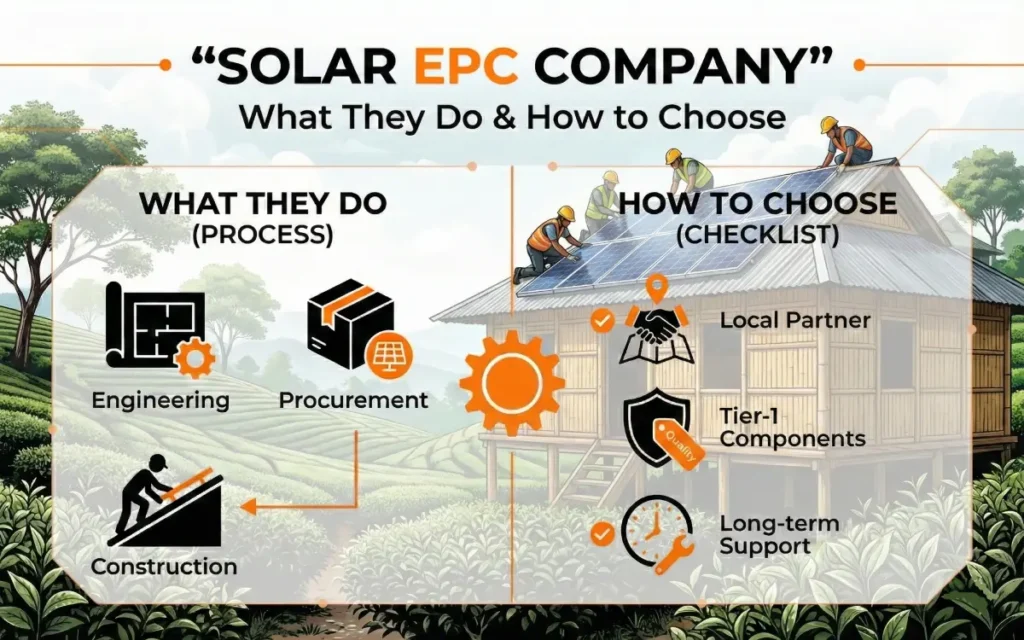
The term EPC stands for Engineering, Procurement, and Construction.
In simple terms, a Solar EPC company is your end-to-end partner. Unlike a simple vendor who just sells you a box of solar panels and wishes you luck, an EPC company takes full responsibility for the entire project—from the moment you think about solar to the moment you switch on the light powered by the sun.
Here is the breakdown of the “EPC” triad:
1. Engineering (The Brains)
This is the planning phase. Every roof in Assam is different—some are slanted tin roofs (common in the Northeast to shed rain), and others are flat concrete.
- Site Survey: The team visits your location to analyze shadow-free areas.
- System Design: They calculate the load (how much power you need) and design a structure that can withstand high wind speeds, which is critical in our region.
- Technology Selection: Deciding between Monocrystalline or Polycrystalline panels, and choosing the right inverter capacity.
2. Procurement (The Sourcing)
A solar system is only as good as its components.
- The EPC company sources Tier-1 solar panels, inverters, mounting structures, and cables.
- They negotiate with manufacturers to get you better prices than you could get as an individual.
- Local Context: Established players in Guwahati, for instance, know exactly which inverters handle voltage fluctuations best.
3. Construction (The Muscle)
This is where the magic happens.
- Installation: Certified technicians mount the structures and panels.
- Electrical Work: Wiring the DC (solar) power to AC (home) power safely.
- Commissioning: The final testing to ensure the system is safe and efficient.
Key Takeaway: A Solar EPC company is not just a seller; they are project managers who handle the headache so you don’t have to.
Why You Need a Specialized EPC in Northeast India
You might ask, “Can’t I just buy panels online and call a local electrician?”
In theory, yes. In practice, this is often a recipe for disaster, especially in the Northeast. Here is why hiring a professional Solar EPC is non-negotiable for our region:
1. Navigating the “Assam Type” Roof
Unlike the flat concrete terraces of Delhi or Mumbai, many homes in Assam, Meghalaya, and Mizoram feature slanted metal roofs (CI sheets) to cope with heavy rainfall. Installing solar panels here requires specialized aluminium rail structures that are lightweight yet leak-proof. A standard electrician may drill holes that lead to leaking roofs during the monsoon—a professional EPC uses non-penetrative clamps where possible.
2. The Subsidy Maze (PM-Surya Ghar Muft Bijli Yojana)
The government (both Central and State) offers attractive subsidies. Under the PM-Surya Ghar Muft Bijli Yojana, you can get substantial financial aid for systems up to 3kW. However, claiming this subsidy requires:
- Registration on the National Portal.
- Feasibility approval from APDCL (Assam Power Distribution Company Ltd).
- Installation by an empanelled vendor.
- Net-metering application and inspection.
A professional EPC company handles this entire bureaucratic chain for you.
3. Weather Durability
The Northeast faces high humidity, heavy rain, and occasional storms. An experienced local EPC will ensure your structure is hot-dip galvanized (rust-proof) and wind-resistant.
The Workflow: How a Project Comes to Life
When you engage with a reputable firm—let’s take Solar Prabha, a well-known EPC provider in Guwahati, as an example of how the process should look—the workflow is structured and transparent.
Step 1: Consultation & Site Visit The team visits your property to assess roof orientation. In the Northern Hemisphere (and thus in India), panels should ideally face South for maximum generation.
Step 2: Quotation & ROI Analysis You receive a detailed quote. This shouldn’t just be a price tag; it should include a Return on Investment (ROI) calculation. Most solar systems in Assam pay for themselves in 3 to 4 years.
Step 3: Engineering & Design For a “Solar Prabha” standard project, this involves selecting high-efficiency panels (often Mono-PERC) that generate electricity even during low-light cloudy days—a common scenario in the Northeast.
Step 4: Liaisoning The EPC submits your documents to the Discom (like APDCL). This is the most time-consuming part if done alone, but fast with an EPC.
Step 5: Installation & Net Metering Once installed, the ‘Net Meter‘ is crucial. It records both the power you take from the grid and the power you give back. Your bill is generated on the “Net” difference.
How to Choose the Right Solar EPC Company: A Checklist
With the solar boom, many fly-by-night operators have appeared. How do you distinguish a reliable partner from a risky one? Use this checklist:
1. Local Presence is King
Solar panels last 25 years. You need a company that will still be around in 5 years to honor the warranty.
- Why it matters: If your inverter trips during a Bihu holiday, you want a team in Guwahati or your local town who can visit within 24 hours, not a call center in a different metro city.
- Tip: Look for companies with a physical office in the region.
2. Check Their “Empanelment” Status
To avail of the PM-Surya Ghar subsidy, your installer must be registered with the local Discom (APDCL). Unauthorized vendors cannot process subsidy applications. Always ask for their vendor ID.
3. Scrutinize the Components
Ask specifically: “What brand of panels and inverters are you using?” A quality EPC will be transparent. For instance, companies like Solar Prabha are known to partner with Tier-1 manufacturers. This ensures that the degradation of your panels is minimal (less than 1% per year). Avoid unbranded (“Chinese non-branded”) panels that flood the market; they may look the same, but fail in 2 years.
4. Ask About “After-Sales” Service (AMC)
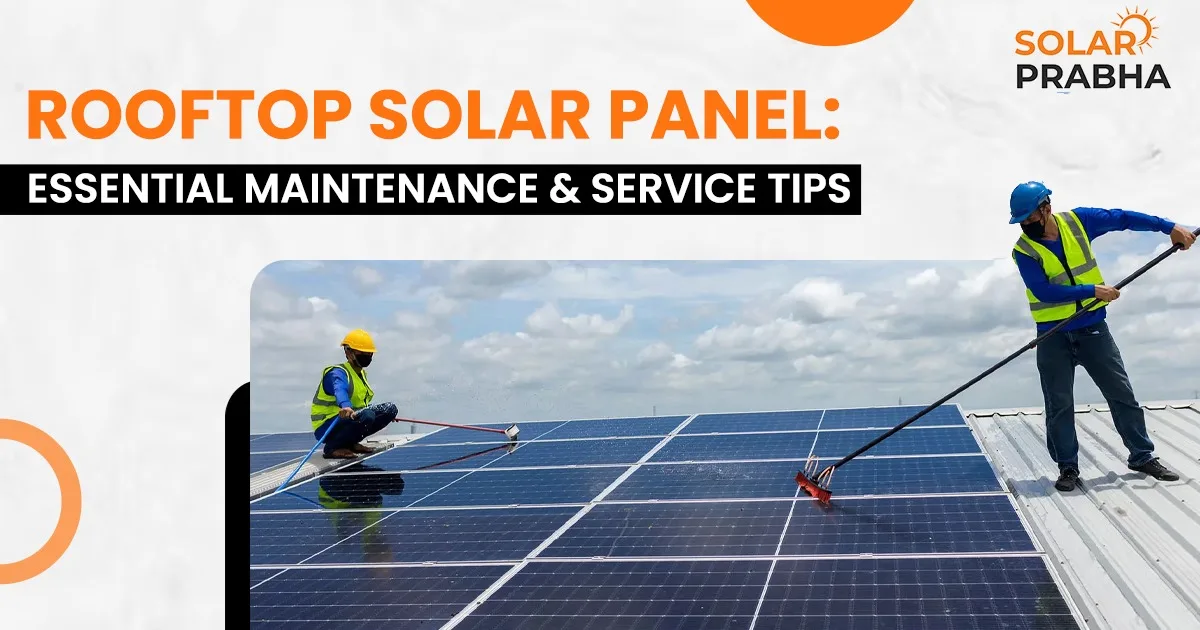
Solar is low maintenance, not no maintenance. Panels need cleaning, and connections need checking. Does the company offer an Annual Maintenance Contract (AMC)?
- Red Flag: If they say “Fit it and forget it,” run away.
- Green Flag: If they offer a schedule for cleaning and health checks.
5. Review Past Projects



Don’t just look at photos; ask for locations. A confident EPC will say, “We installed a 5kW system in Beltola last month; you can go see it.” Local examples of Solar Prabha installations in residential Guwahati or commercial setups in industrial estates serve as live proof of their capability.
Spotlight: The Importance of a Trusted Partner
In the crowded market of Northeast India, credibility is the currency.
One name that frequently comes up in conversations regarding reliable solar infrastructure in Guwahati is Solar Prabha. As a unit of Kailash Chand & Sons, they carry a legacy of trust that is vital in the construction and engineering sector.
What makes an EPC like Solar Prabha stand out is not just their ability to screw panels onto a roof, but their approach to the “Assam-specific” challenges:
- Customized Structures: They understand that a one-size-fits-all structure doesn’t work for the varied roof types in the Seven Sisters.
- Subsidy Expertise: Their team is well-versed in the latest updates to the PM-Surya Ghar scheme, ensuring clients don’t miss out on financial benefits due to paperwork errors.
- Inventory: Being a local powerhouse, they often have stock ready (panels, inverters, solar pumps), reducing the waiting time for customers compared to ordering from national aggregators.
While there are many players in the market, choosing a company that combines technical EPC expertise with local roots is usually the safest bet for a 25-year investment.
The Financial Angle: Cost vs. Investment
Many people in Assam hesitate because of the upfront cost. Let’s break the myth.
The Math of Solar in Assam:
- Average Cost (3kW system): Approx. ₹1.5 Lakhs – ₹1.8 Lakhs (before subsidy).
- Subsidy: Under the new scheme, you could receive roughly ₹78,000 (for systems up to 3kW).
- Net Cost: ~ ₹70,000 – ₹1 Lakh.
- Monthly Savings: A 3kW system generates approx. 300-360 units per month. At ₹7/unit, that’s a saving of ~₹2,500/month.
- Payback Period: ~3 years.
- Free Electricity: For the remaining 22 years of the panel’s life.
An efficient EPC company will provide this calculation in black and white before you sign a single document.
Conclusion: The Sun is Rising in the East
The Northeast region has often struggled with power reliability, but we are also blessed with a good amount of daylight (despite the rain!). By switching to solar, you aren’t just saving money; you are insulating yourself from tariff hikes and contributing to a greener Assam.
However, the bridge between “wanting solar” and “having solar” is the EPC company you choose. Do not compromise on quality for a slightly cheaper quote. Your roof is a valuable asset—treat it with respect by hiring professionals.
Whether you explore options like Solar Prabha or other empanelled vendors, ensure they tick the boxes of local presence, technical certification, and transparent support.
Ready to stop paying high electricity bills? The best time to plant a tree was 20 years ago. The best time to install solar is today.