In recent years, solar energy has emerged as one of the most reliable and sustainable sources of power, especially in regions like Northeast India, where sunlight is abundant but grid reliability can vary. As electricity costs rise and environmental concerns grow, many homeowners and businesses are turning to solar systems to reduce bills and achieve energy independence.
Two primary types dominate the market: on-grid solar systems (also known as grid-tied) and off-grid solar systems (standalone). Understanding the key differences between off-grid and on-grid solar systems is crucial before investing. This guide breaks down how each works, its pros and cons, costs, and which might suit your needs best in 2025.
What is an On-Grid Solar System?
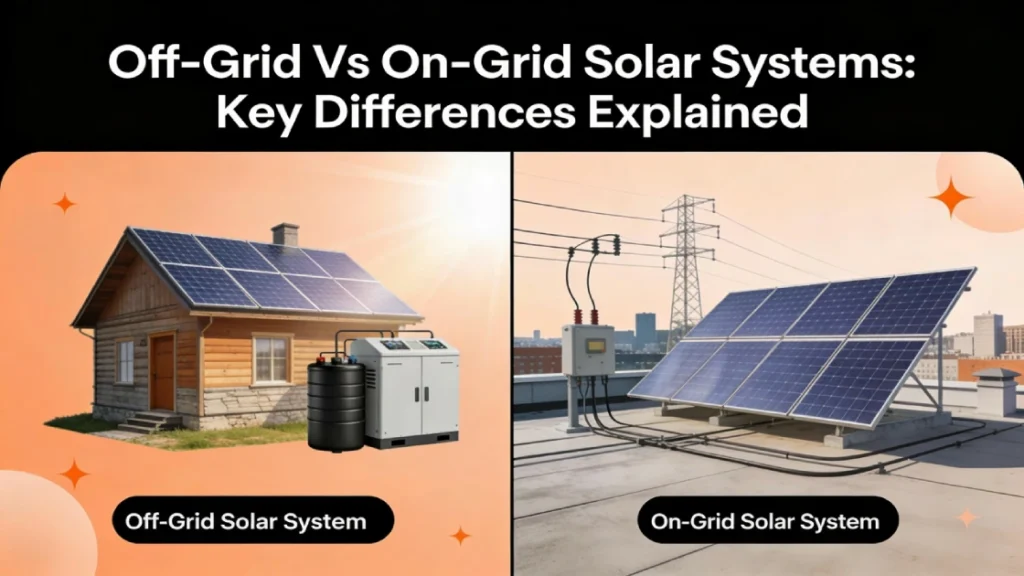
An on-grid solar system connects directly to the local electricity grid. Solar panels generate DC electricity during the day, which an inverter converts to AC power for home use. Any excess energy is fed back to the grid through net metering, earning credits on your bill.
When solar production is low (at night or on cloudy days), the system automatically draws power from the grid. No batteries are typically needed, keeping the setup simple and efficient.
On-grid systems are ideal for urban and semi-urban areas with stable grid connections. In India, they qualify for attractive subsidies under schemes like PM Surya Ghar Muft Bijli Yojana, making them more accessible.
What is an Off-Grid Solar System?
An off-grid solar system operates completely independently of the utility grid. It includes solar panels, a charge controller, batteries for storage, and an inverter.
Excess daytime energy charges the batteries, providing power during non-sun hours or outages. This setup ensures uninterrupted supply even in remote locations.
Off-grid systems offer true energy independence but require careful planning for battery capacity and load management. They are popular in rural or hilly areas where grid extension is challenging or unreliable.
Key Differences Between Off-Grid and On-Grid Solar Systems
Here’s a clear comparison to highlight the main distinctions:
- Grid Dependency: On-grid relies on the grid for backup and excess export; off-grid is fully independent with no grid connection.
- Components: On-grid needs panels, an inverter, and a net meter. Off-grid adds batteries and charge controllers, increasing complexity.
- Power Availability: On-grid may stop during grid outages (without hybrid upgrades). Off-grid provides 24/7 power via stored energy.
- Excess Energy Handling: On-grid sells surplus via net metering. Off-grid stores it in batteries or risks wastage if full.
- Maintenance: On-grid is low-maintenance. Off-grid requires regular battery checks and replacements.
- Scalability: On-grid easily expands with grid support. Off-grid scaling involves costly battery upgrades.
These differences make each system suited to specific lifestyles and locations.
Pros and Cons of On-Grid Solar Systems
Advantages:
- Lower upfront costs due to no batteries.
- Quick payback (3-5 years) through bill reductions and net metering credits.
- Eligible for government subsidies, reducing effective costs significantly.
- Environmentally friendly with minimal waste.
Disadvantages:
- No power during grid failures unless hybridized.
- Dependent on utility policies for net metering rates.
- Less suitable for areas with frequent outages.
Pros and Cons of Off-Grid Solar Systems
Advantages:
- Complete energy independence – ideal for remote or outage-prone areas.
- Reliable backup during blackouts or load shedding.
- No monthly bills and protection from tariff hikes.
- Portable and expandable for off-grid living.
Disadvantages:
- Higher initial investment due to battery costs.
- Limited by battery capacity on cloudy days or high usage.
- Batteries need replacement every 5-10 years, adding long-term expenses.
- Potential energy loss if storage is insufficient.
Cost Comparison in 2026
Costs vary by capacity, components, and location, but here’s an overview for a typical 3kW residential system in India:
- On-Grid: ₹1.5-2.5 lakh before subsidy. With PM Surya Ghar benefits (up to ₹78,000 for 3kW), effective cost drops to ₹1-1.5 lakh. Northeast regions like Assam may get additional incentives.
- Off-Grid: ₹2.5-4 lakh or more, including quality batteries. Limited or no central subsidies, though some state schemes apply.
On-grid systems generally offer better ROI in grid-connected areas, with payback in 4-6 years. Off-grid suits long-term independence but takes longer to recover costs.
Factors influencing prices include panel efficiency (Mono PERC or TOPCon), inverter brand, and installation quality. Always factor in warranties – panels last 25+ years, inverters 10-12 years.
Which System is Right for You?
The choice depends on your location, power needs, and grid reliability:
- Choose on-grid if you have stable grid access, want to minimize costs, and benefit from subsidies/net metering. It’s perfect for most urban homes aiming to slash bills.
- Opt for off-grid if you’re in remote areas, face frequent outages, or prioritize independence (e.g., hilly Northeast regions).
- Consider a hybrid system as a middle ground – grid-connected with battery backup for the best reliability.
In Northeast India, including Assam, abundant sunshine supports both, but varying grid stability makes hybrids increasingly popular.
Environmental and Long-Term Benefits
Both systems reduce carbon footprints by harnessing clean solar energy. Switching to solar cuts reliance on fossil fuels, lowers emissions, and contributes to India’s renewable goals.
Over 25 years, a typical system generates free power after payback, offering massive savings and energy security.
Conclusion
Understanding off-grid vs on-grid solar systems empowers you to make an informed decision tailored to your needs. On-grid offers affordability and integration for most users, while off-grid delivers unmatched independence for challenging locations.
If you’re ready to explore solar solutions in Assam or anywhere in the Northeast, reach out to Solar Prabha in Guwahati for expert guidance on installations, subsidies, and customized systems. Contact us at +91-9394245778 to start your solar journey today.