Solar panels are found on almost every building and across the world, from urban centers to rural remote areas. Solar panels are used to collect and convert sunlight into electricity, and they are essential for clean, renewable electricity, whether that is topping the roofs of residential homes or industrial-scale installations. But how are solar panels made? What is the manufacturing process for these beautiful glass-and-silicon systems that create electricity from light?
Through this blog, we will walk through the complete manufacturing process of a solar panel, providing an easy-to-read step-by-step overview of manufacturing solar panels from raw silicon to an assembled panel. We’ll also cover the material information about solar panels, including what solar panels are made of, how solar panels work, and what innovations we might see in the near future of solar panels.
If you want to understand what happens in the manufacturing of the technology that generates electricity for millions of homes and businesses, you will get some answers here.
The Basics: What Is a Solar Panel?
Before we dive into solar panel manufacturing, it’s helpful to understand what a solar panel is and how it works.
Essentially, a solar panel is a device that captures sunlight and transforms it into usable electricity. This is achieved using photovoltaic (PV) cells, which are the active components of the solar panel. A typical solar panel has dozens of PV cells that work together to generate power using the sun’s energy.
The dominant material in PV cells is silicon, one of the most common elements in nature, found in sand. Silicon is used due to its semiconductor characteristics, meaning that it conducts electricity under some conditions, making it ideal for converting solar power into an electric current.
In simple terms, here’s how it works: when the sunlight strikes a solar cell, the energy from the light knocks electrons loose from their atoms in the silicon. The free-moving electrons are captured and directed along an electric circuit to produce flowing electricity. This is called the photovoltaic effect.
Once the electricity is generated, it can be used to power lights and appliances, or it may be stored in batteries for later use. All solar panels, whether on a single rooftop system or in a massive solar farm, are built on this same principle.
Materials in Solar Panels
A solar panel does not see the sun until it is made from the materials selected for use in its manufacture. Each of those materials has been selected for various reasons, including life span, efficiency and compatibility in a harsh outdoor environment. It does not just come together randomly; it comes together in the form of materials that are designed to last.
All of the materials play a role in delivering an energy device; there is silicon to take the light in, glass to protect it, and a frame to allow for mounting methods. Let’s investigate each of the materials that are utilized in solar panels and what they ultimately do.
The main materials that make up solar panels are:
- Silicon: The most important material. It is used to create solar cells.
- Glass: Protects the top of the panel and covers the cells.
- Aluminium: Used for the frame of the panel.
- EVA (Ethylene Vinyl Acetate): Used for the clear encapsulation of the cells.
- Backsheet: Usually a polymer coating (on the back of the panel) providing insulation and protection.
- Silver and copper: Needed for electrical conductivity within the panel.
All these elements are integral to an efficient, durable solar panel that can withstand the elements.
Step-by-Step Solar Panel Manufacturing Process
It’s easy to look at solar panels and not think much of them – they appear flat, sleek, and quietly doing their job on rooftops and in outdoor fields. However, there is surprisingly more that goes on behind each solar panel production journey. The manufacturing of solar panels is a detailed process that takes raw materials and refines them into a final product. Understanding how solar panels are manufactured is a process of science, engineering, and precision.
Let’s take a step-by-step look at how solar panels are manufactured and how they go from raw silicon to a fully functioning renewable energy source.
Step 1: Purification of the Silicon
In the beginning, the starting rock is raw quartz or sand, which is purified to ultra-pure silicon. In this purification step, the rock is heated in a furnace to over 2000°C to create metallurgical-grade silicon.
The next step in order to utilize silicon for solar cells, the silicon is then chemically purified even further in a process called the Siemens process. After the purification process, the end product is polycrystalline silicon, which is then melted down and cast into ingots.
Step 2: Making Silicon Wafers
The silicon ingots are then sliced into very thin sheets, called wafers, so thin that they are only around 0.2 mm thick; thinner than a strand of hair.
There are two common types of wafers:
- Monocrystalline wafers: Cut from a single silicon crystal; more efficient; a little more expensive.
- Polycrystalline wafers: Made from melted silicon crystals jammed together; slightly less efficient; cheaper.
The wafers are then cleaned and polished to clean them up.
Step 3: Doping and Texturing
Afterwards, the wafers go through doping, Phosphorus or boron, etc, are added
They now have the electrical properties to create electricity from sunlight.
To improve light absorption, the top surface of each wafer is textured in a way that reduces reflection and traps more sunlight.
Step 4: Adding the Metal Conductors
When the wafers are finished being doped and textured, very fine lines of silver paste are printed on the surface of the wafer. These fine lines act as electrical contacts to collect the electric current you have created.
Then a layer of aluminium is applied to the back side of the wafer. The entire wafer is then baked to high temperatures to solidify the metal contacts – this is called firing.
Step 5: Connecting the Solar Cells
The individual solar cells are now complete, but they cannot stand alone. It takes about 60 to 72 cells to form one solar panel.
The cells are soldered together in a series using thin metal strips, so that the current may flow from one cell to the next. In turn, it supplies power to your home or business.
Step 6: Encapsulation
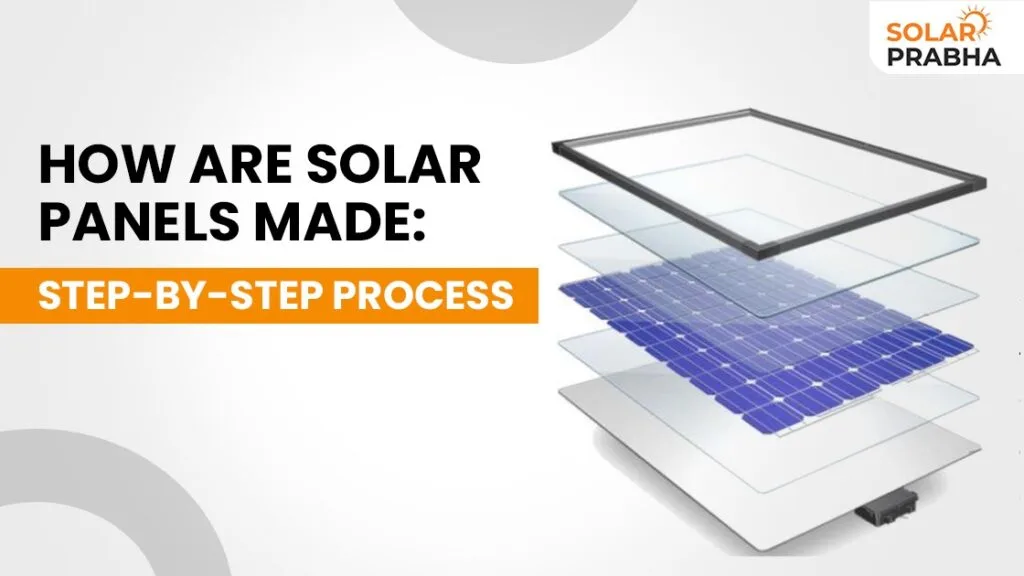
After the cells are connected, they then get encased in protective layers. Here is what that looks like:
- Front: Tempered glass to protect the cells from hail, wind, and rain.
- Middle: EVA films above and below the cells to cushion and insulate them.
- Back: A backsheet (most often polymer) for protection from moisture and dust.
The laminate layers are laminated under heat and vacuum to seal the components together and keep air or water from getting in.
Step 7: Framing the Panel
The laminated element is then placed into an aluminium frame. The frame, which must be corrosion-resistant, provides the structural component of the panel, making it mountable to roofs or installed on the ground.
The frame has junction boxes on the back, which is where the electrical connections are housed. This is also the location of the bypass diodes to control power flow and protect panels from shading issues.
Step 8: Testing and Quality Control
No panel leaves the factory without inspection.
Every panel is subjected to testing under Standard Test Conditions (STC). We assess performance metrics including: voltage, current and power output and for similar panels:
- Microcracking
- Electrical mismatches
- UV & moisture resistance
- Potential induced degradation (PID)
Only panels that meet international setup standards, such as IEC or UL, can receive certification and are eligible for shipment.
How Sustainable is Solar Panel Manufacturing?
It’s a good question – isn’t it an energy-intensive process? Of course, the manufacturing itself costs energy; however, the energy payback time of a typical solar panel is 1 to 3 years. Since panels last for over 25 years, they make much more energy than they cost in manufacturing.
Manufacturers are increasingly adopting greener operations as well, such as:
- Recycling silicone waste
- Using renewable energy in factories
- Minimising the amount of toxic materials used
- Designing panels for easier recycling at end-of-life
Improvements in the Process of Manufacturing Solar Panels
Solar technology has not stood still, and honestly has gone so far as to say that it is filling the need to become even more efficient, carbon neutral and more appealing manufacturing processes over the last decade.
Solar technology manufacturing is based on solar technology applications and described as a complex set of manufacturing parameters, so as demand grows and technology grows, manufacturers are pushing those limits to develop smarter, lighter, and more cost-efficient panels. Below are a few recent innovations that are developing and that are impacting the future of solar energy.
- Perovskite Solar Cells: A breakthrough material that could compete with silicon in both efficiency and cost.
- Bifacial Panels: These panels are able to absorb sunlight from both the front and the back side, which enhances output.
- Thin-film Technology: As the name implies, thin film is a light panel that has flexible applications.
- AI and Automation: AI is utilized in factories to make processes more precise and limit waste.
Main Takeaway Points: The Whole Process from Sand to Solar
Here we have provided a short recap of how solar panels are made:
- Pure silicon is extracted from sand and shaped into ingots. Ingots are cut into thin wafers. Wafers are treated, doped and textured to improve performance.
- Conductive materials are added to form working solar cells.
- Cells are assembled, enclosed and framed into full panels.
- Panels are tested for quality, performance and durability.
It is a perfect combination of science and engineering and precision – and it all happens so you are able to capture clean, renewable energy directly from the sun.
Conclusion
Understanding how solar panels are made provides a better appreciation and understanding of the technology that makes clean and renewable energy systems possible. From the raw materials that are used in solar panels to the many complex steps in the solar panel production process, it is all science, accuracy and innovation to produce solar solutions that are effective long-term options.
Solar Prabha stands as Assam’s trusted solar partner, dedicated to supplying and installing high-quality solar systems tailored to local energy needs. For expert guidance and the finest options to power homes and businesses sustainably, reach out at +91-7099030047 or visit our Guwahati office—let’s illuminate your world with reliable solar energy.